Whale Shark Sightings in the Gulf of Thailand: Two Years of Dive Logs
TL;DR — Across roughly two years of daily dive reports (October 2023 – August 2025), our crews logged 42 whale shark sightings on 30 separate days around Sail Rock, Chumphon Pinnacle and the Koh Tao area. The peak months are May and August, conditions skew calm and clear (10 m+ viz, sub-1 m seas), and — surprisingly — the lunar phase that produced the most sightings was the Last Quarter, not the full or new moon.
If you’ve ever fallen down a Google rabbit hole asking “when is the best time to see whale sharks in the Gulf of Thailand?”, you’ve probably read the same generic “March to May and September to October” line on twenty different dive blogs. While our guide to the Sail Rock whale shark season covers the mechanics of why they show up, we wanted to go further and look at the actual hard data — so we went into our own dive logs.
Every day, our skippers and instructors radio back the morning’s conditions and any notable encounters into a shared chat: visibility at the pinnacle, sea state, boat assignments, and — when it happens — the magic two words: “whale shark.”
This post is the result of parsing every one of those messages since October 2023 and turning the raw chatter into something a future diver can actually plan a trip around.
The headline numbers
- 42 total whale shark mentions
- 30 unique days with a confirmed sighting
- ~23 months of data (Oct 2023 → Aug 2025)
- 10.9 m average visibility on sighting days
- 0.69 m average wave height on sighting days
- 9 of 30 sighting days fell in the Last Quarter lunar phase
- Sail Rock remains the single most-mentioned location
That’s roughly one whale shark day every three weeks across our operation — and they tend to clump into a handful of very good months. Note that we run trips to Sail Rock on Tuesdays, Wednesdays, Fridays and Sundays only, so the real number on the reef is almost certainly higher than what we record.
When are you most likely to see a whale shark?
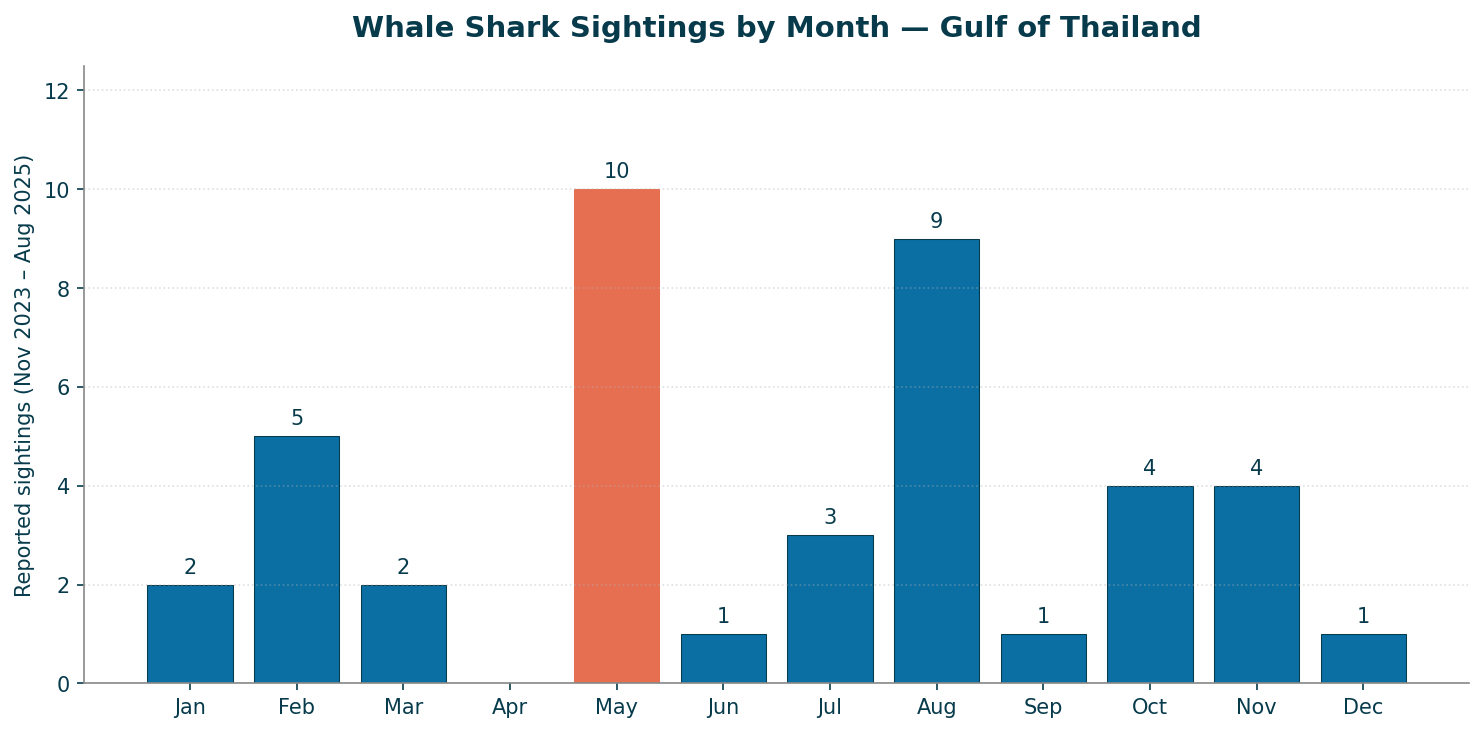
This is the chart most people are here for. Each bar is the total number of whale shark sightings our crews logged in that month, summed across years.
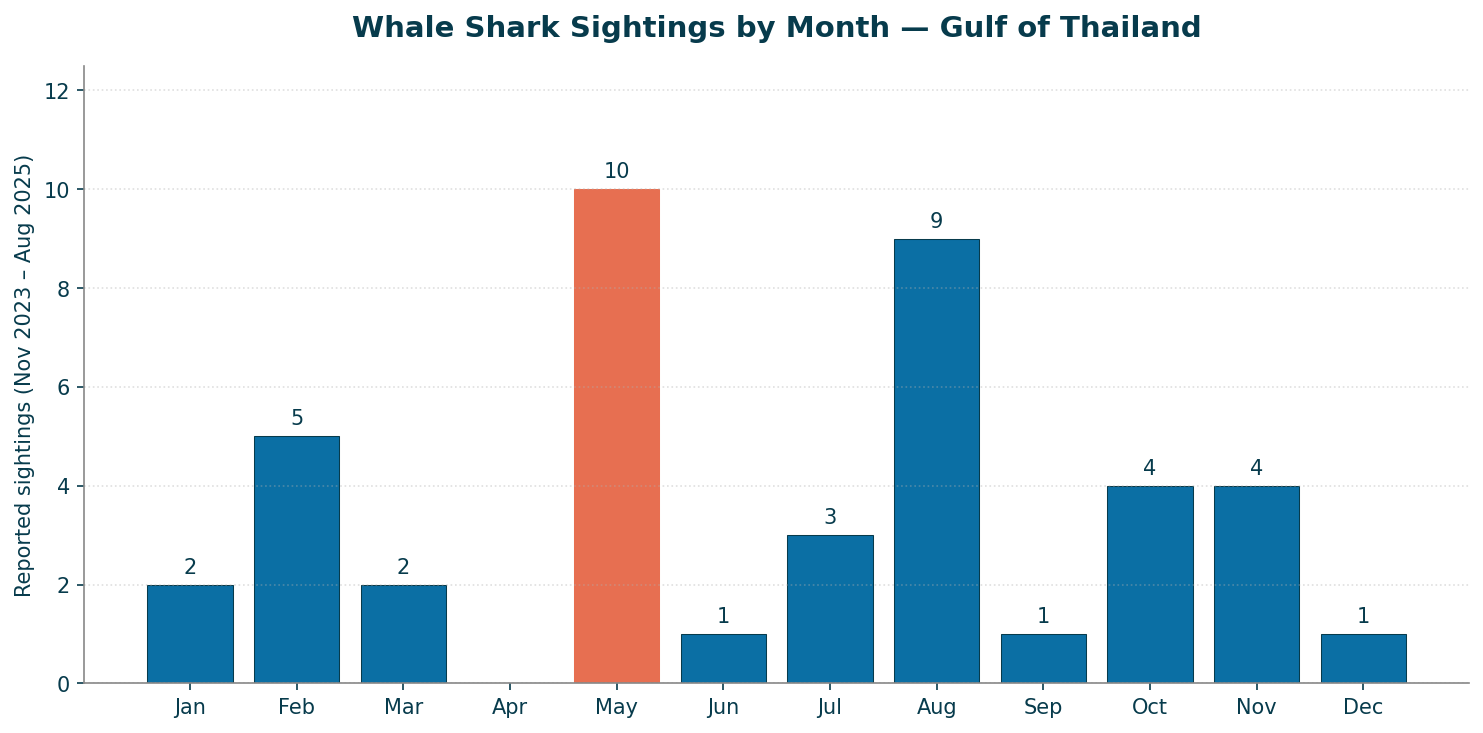
The pattern is unmissable:
- May is the standout month with 10 sightings — the highest of any month in our data.
- August is a close second with 9 sightings, lining up with the warm-water lull between monsoon swings.
- February, October and November all cluster around 4–5 sightings each — a respectable shoulder season.
- April is the only month with zero recorded sightings in our data set. Take that with a pinch of salt — April is also one of our quietest months for boat trips, so absence of evidence isn’t evidence of absence.
If you’re optimising a single trip purely for whale shark odds, May and August are the two months to circle on the calendar. If you’re already coming for a different reason, you’ve still got a real chance any month from October through August — only April looks consistently slow.
Year over year: are sightings actually increasing?
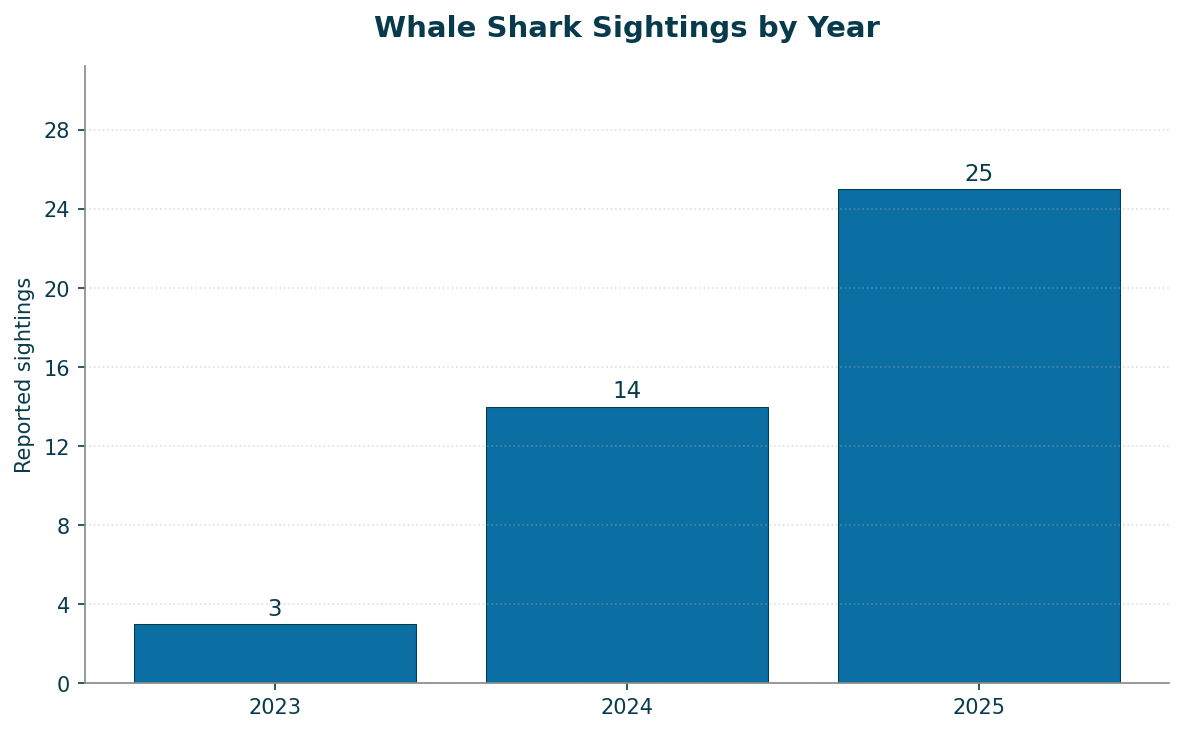
On the surface this looks like a beautiful upward trend — 3 sightings in 2023, 14 in 2024, 25 already in 2025. Cue the breathless headlines about whale sharks returning to the gulf.
We’re going to be honest about this one, though: the comparison is not apples-to-apples.
- 2023 data only starts in October — so it covers a single quarter, not a full year, and the first sighting we logged is from 7 November.
- 2025 only goes through the end of August — and August happens to be one of the two peak months.
- Reporting habits in the chat have also gotten more consistent over time.
So while the trend is genuinely encouraging — 2024 was a strong full year, and 2025 was already at 25 sightings before the end of August — we’d want a couple more complete seasons before declaring a real population trend. What it does clearly show is that whale shark encounters in the Gulf of Thailand are not a rare, once-a-season event. They are a regular, expected part of the dive year.
What conditions favour a sighting?
Every dive report in the chat that mentioned a whale shark also tended to mention the conditions. Here’s what those days looked like:
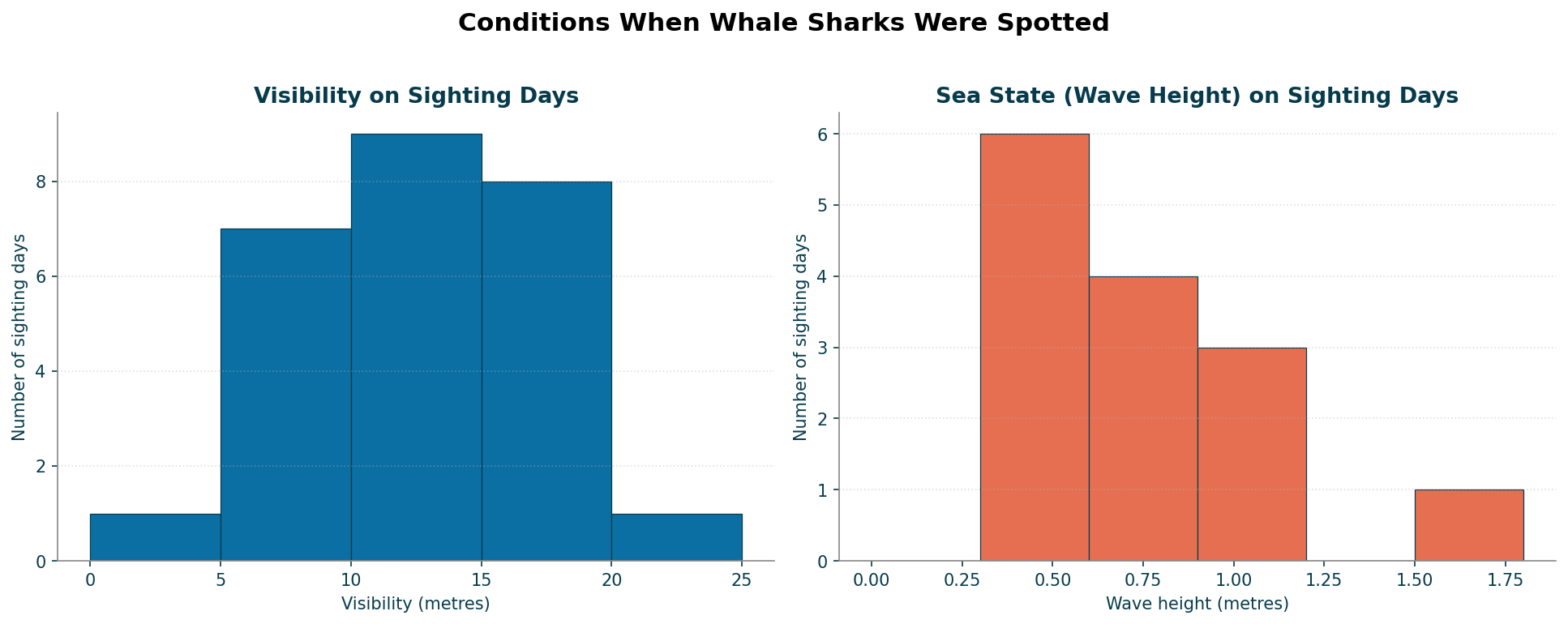
A couple of things stand out:
Visibility was rarely “perfect” — and it didn’t need to be. Most sightings happened in 5–20 m of viz, with the largest cluster in the 10–15 m band. Plenty of encounters happened in the 5–10 m range, which is the gulf’s everyday plankton-rich norm. Whale sharks are filter feeders. A bit of soup in the water is exactly what brings them in.
Calm seas dominate. Almost every recorded sighting happened with wave heights under 1 m, and most under 0.7 m. This isn’t necessarily because whale sharks dislike chop — it’s because choppy days mean fewer divers in the water at Sail Rock, and Sail Rock is where they show up. Lesson: if you wake up and the sea looks like glass, that’s the morning to be on the boat.
Does the moon matter? Whale shark sightings by lunar phase
Marine biologists have long suspected that lunar cycles influence whale shark behaviour — both via the tides they drive and via the plankton blooms that are tied to them. We had the dates, so we ran the numbers.
For each of our 30 sighting days we computed the moon’s age (days since the previous new moon) at noon Bangkok time and bucketed it into one of the eight standard phases. The dashed line shows what the bars should look like if sightings were spread uniformly across the lunar month — about 3.75 sighting days per phase.
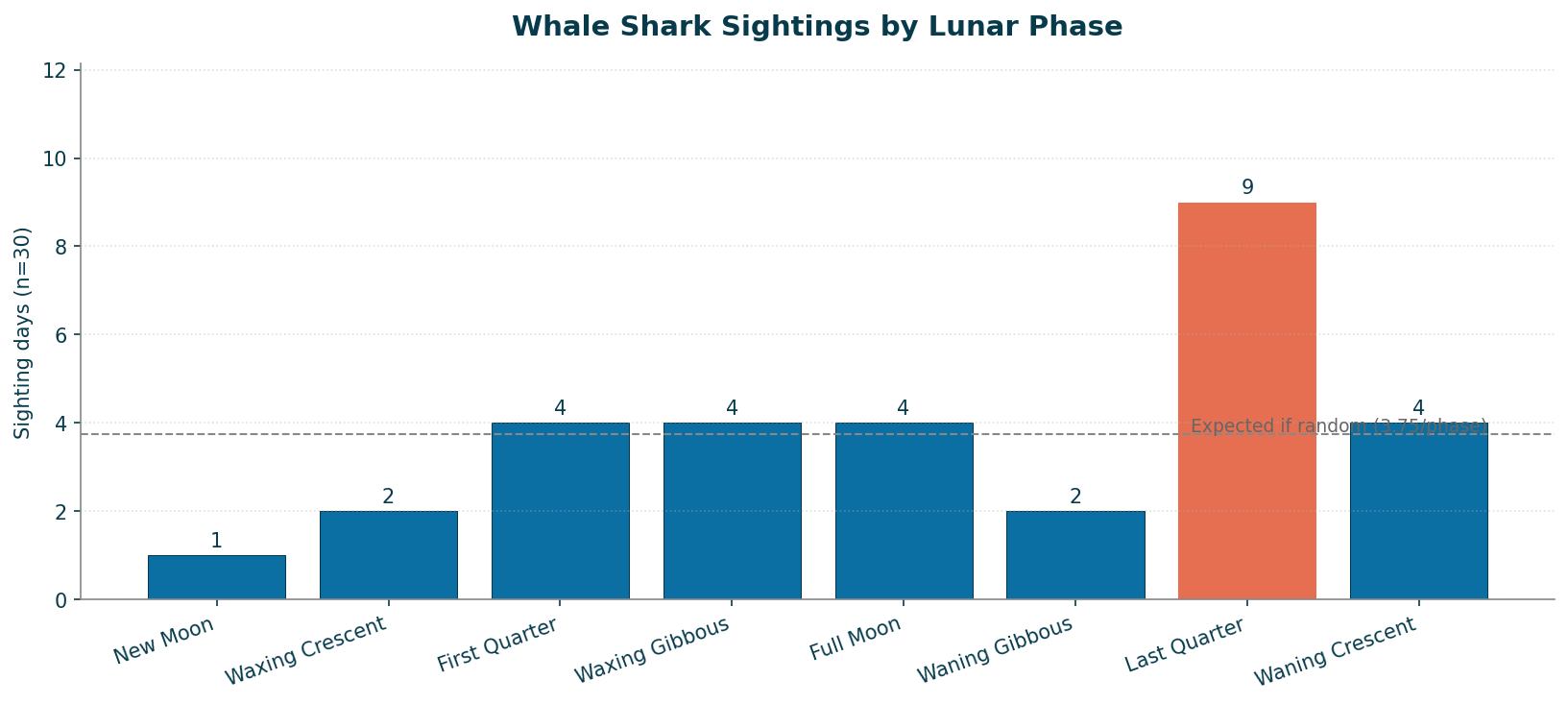
The chart has one obvious outlier: Last Quarter — 9 sighting days out of 30, against an expected 3.75. That’s roughly 2.4× the random baseline, and on its own it accounts for nearly a third of every whale shark we recorded.
A few honest hedges before you re-book your dive trip around the moon:
- Sample size is small. Thirty data points across eight phases gives wide confidence intervals — a Last Quarter cluster of 9 isn’t yet statistically airtight on its own.
- First Quarter, Waxing Gibbous and Full Moon all sit right at the expected baseline (4 each). The “full moon = whale sharks” folk wisdom doesn’t really show up here.
- New Moon and Waning Gibbous are quietest (1 and 2 sightings) — but again, small numbers.
Our best read: there’s a suggestive signal that the days running from Full Moon down through Last Quarter into Waning Crescent are the strongest stretch, and that the Last Quarter window in particular is worth keeping an eye on. We’ll keep collecting data and revisit this in a year. If you’re stacking your odds, a calm-sea morning trip to Sail Rock around the Last Quarter is the most data-backed bet we can give you right now.
Where to see them: the Gulf of Thailand sites that matter
The vast majority of our sightings happened at three sites, all reachable as a day trip from Koh Samui or Koh Phangan:
- Sail Rock — the gulf’s most reliable whale shark site, a single seamount rising from open water between Koh Phangan and Koh Tao. If you only do one trip, do this one.
- Chumphon Pinnacle — the Koh Tao side of the same general system. Slightly further to reach, but a strong second option.
- Koh Tao house reefs (Mango Bay, Tao Toh, Twins) — occasional surprise encounters, particularly in the warmer months.
A few of our biggest days — three separate sightings in a single day on 29 October 2024 and again on 23 May 2025 — were at Sail Rock. When the conditions line up, whale sharks tend to circle the pinnacle for hours and multiple boats get to share the moment.
How we built this data set
For the data nerds (and for transparency):
- Source: our internal WhatsApp dive-log group, where skippers and instructors post daily conditions. The digital log starts in October 2023 and runs through the end of August 2025.
- Parser: every message timestamped
MM/DD/YYwas extracted, multi-line messages were stitched back together, and the keywordwhale shark(singular, plural, with or without spaces) was matched case-insensitively. - Conditions: for every dated message we also extracted any mention of visibility / viz / vis in metres, and any mention of waves / swell / sea state in metres. Those are aggregated per day before being plotted.
- Moon phase: lunar age was computed with
pyephemagainst the previous new moon, evaluated at 12:00 Bangkok time on each sighting date, then bucketed into the eight standard phases.
Important caveats
- The 2023 row is a partial year. Our digital log only starts in October 2023, so 2023 covers three months, not twelve.
- Sail Rock is a 4-day-a-week site. We run trips to Sail Rock on Tuesdays, Wednesdays, Fridays and Sundays. On the other three days of the week our boats are diving Koh Tao or local sites, so any whale shark that visited the pinnacle on a Monday, Thursday or Saturday is a sighting we never had a chance to record. The true on-reef encounter rate is almost certainly higher than what you see here.
- These are mentions, not census data. A single shark seen by three boats can be reported three times. A shark that no one mentioned simply doesn’t appear.
- No de-duplication across boats — we treated each report as one signal that conditions on that day were good enough to produce an encounter.
- Future-dated typos were dropped before plotting.
- The moon-phase signal is suggestive, not conclusive — n=30 sighting days is not enough to draw a hard astronomical conclusion. We’ll revisit at year-end.
The parsing script and the chart generator are kept under version control with the rest of our internal tools, so we can refresh this analysis at the end of every season.
So when should you book?
If you take one thing away from this post, take this: the Gulf of Thailand is a real whale shark destination. Not a once-in-a-blue-moon hope. A regular, statistically backed possibility — especially if you time your trip well.
- Best months: May and August
- Strong shoulders: February, October, November
- Sleeper picks: January, March, July
- The quiet month: April
- Best moon window (so far): the days running from Full Moon down through Last Quarter
- Sail Rock day of the week: Tuesday, Wednesday, Friday or Sunday — those are the only days we run the trip
Pick a calm-sea morning that lines up with one of our Sail Rock days, and your odds are as good as they get in the gulf.
Want to dive Sail Rock with us? Check our dive trips, or contact the shop directly — we’ll let you know when the next whale shark window looks promising.
About this analysis — All data was extracted from our own daily dive reports between October 2023 (when the digital log began) and 31 August 2025. The first whale shark we logged is from 7 November 2023. Sail Rock trips run Tuesdays, Wednesdays, Fridays and Sundays, so additional sightings on Mondays, Thursdays and Saturdays are unrecorded. We’ll refresh these charts at the end of each calendar year. If you’re a researcher, conservation NGO or a fellow operator and want the underlying anonymised data, get in touch.